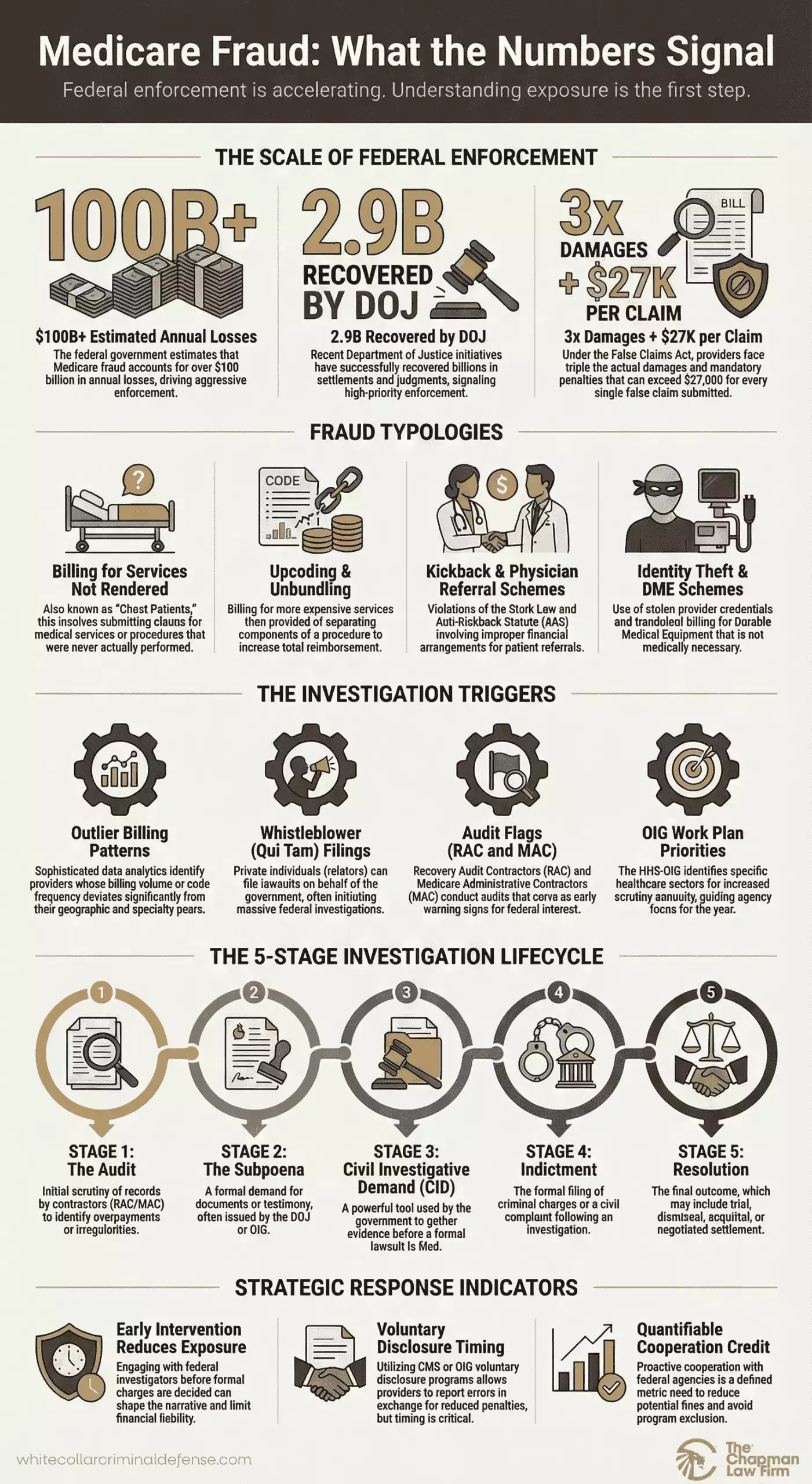
Medicare Fraud Defense Overview
For healthcare professionals, medical groups, pharmacies, and executives, a Medicare fraud allegation does more than threaten your business—it puts your entire professional life on the line. These accusations strike at your integrity, jeopardize your license, disrupt your livelihood, and expose you to staggering financial and criminal consequences. With federal agencies moving aggressively and often without warning, even the early stages of an investigation can feel isolating and overwhelming.
At Chapman, Dowling & Mallek, we understand what you are up against. This is a complex, unforgiving area of federal law, and the government’s enforcement tools are immense. Our role is to stand between you and that machinery—deploying strategic, experienced defense to protect your license, your practice, and your freedom. When your career is under threat, you deserve a defense team that knows how to shut investigations down, fight inaccurate allegations, and navigate these cases with precision and discretion.
What Medicare Fraud Defense Really Involves
Medicare fraud defense is far more than arguing innocence. It requires a precise understanding of federal healthcare regulations, billing rules, medical-necessity standards, and the government’s enforcement strategies.
A proper defense demands:
- A deep analysis of billing, documentation, Medicare Parts A–D, and coding practices.
- Challenging government assumptions regarding intent, necessity, or compliance.
- Responding strategically to audits, subpoenas, OIG inquiries, and grand jury investigations.
- Proactively managing risk and mitigating penalties before they escalate.
- Litigating aggressively when the government overreaches.
Simply put, it is the construction of a legal and regulatory shield—one strong enough to withstand the full weight of federal scrutiny while preserving your professional future.
Common Medicare Fraud Allegations
Federal authorities investigate a wide range of conduct under the umbrella of Medicare fraud. Allegations commonly include:
- Billing for Services Not Rendered
Claims for treatments, equipment, or services that were never provided—or provided by unqualified personnel. - Upcoding
Using billing codes for higher-level or more expensive services than were actually performed. - Unbundling
Submitting separate claims for services that should be billed together as a single reimbursable unit. - Medical Necessity Issues
Billing for procedures, tests, or equipment that lack adequate documentation or genuine clinical need. - Kickbacks & Referrals
Any remuneration tied to referrals, implicating the Anti-Kickback Statute and the Stark Law. - Prescription & Part D Fraud
Improper dispensing, diversion, unnecessary prescriptions, or manipulation of formularies. - Routine Waiver of Co-Pays/Deductibles
Reducing or eliminating required patient responsibility without lawful justification. - Identity Theft
Using patient Medicare numbers to submit fraudulent claims. - False Certifications
Signing documents—plans of care, CMNs, proof of delivery—containing inaccurate or misleading information.
Federal Agencies That Investigate Medicare Fraud
Medicare fraud investigations draw on some of the most powerful agencies in the federal government:
- Department of Justice (DOJ) – Leads civil and criminal prosecutions and often works through the Medicare Fraud Strike Force.
- Office of Inspector General (HHS-OIG) – Investigates fraud, waste, and abuse; issues CMPs and exclusions.
- Federal Bureau of Investigation (FBI) – Conducts criminal investigations, executes search warrants, and gathers evidence.
- Centers for Medicare & Medicaid Services (CMS) – Identifies irregular billing, initiates audits, and imposes administrative actions.
- Drug Enforcement Administration (DEA) – Leads investigations involving prescription drugs, controlled substances, and dispensing practices.
When these agencies coordinate, cases can escalate quickly—which is why early legal intervention is critical.
Penalties for Medicare Fraud
The consequences of a Medicare fraud case can be life-changing. Depending on the allegations, potential penalties include:
- Federal Imprisonment
Serious fraud charges often carry lengthy sentences, enhanced when large sums or patient harm are alleged. - Massive Fines & Restitution
Penalties can reach millions, including statutory fines and repayment of alleged overbilling. - Exclusion from Federal Programs
Losing access to Medicare/Medicaid often ends a practitioner’s ability to operate. - Loss of Medical or Professional Licenses
State licensing boards frequently impose discipline following federal investigations or convictions. - Civil False Claims Act Penalties
Treble damages plus per-claim penalties, which add up quickly in high-volume practices. - Asset Forfeiture
Seizure of bank accounts, property, or other assets tied to alleged fraudulent conduct. - Reputational Damage
Accusations alone can harm a career; a conviction can destroy it.
Key Statutes in Medicare Fraud Cases
Medicare fraud cases are driven by a small number of powerful federal statutes:
The False Claims Act (31 U.S.C. § 3729) Imposes liability for knowingly submitting false claims—including reckless disregard or deliberate ignorance.
The Anti-Kickback Statute (42 U.S.C. § 1320a-7b(b)) Criminalizes offering or receiving anything of value tied to federally reimbursed referrals.
The Stark Law (42 U.S.C. § 1395nn) Bars physician self-referrals for designated health services unless a specific exception applies. Intent is not required.
The Federal Health Care Fraud Statute (18 U.S.C. § 1347) Broadly prohibits schemes to defraud healthcare benefit programs, often used as the government’s main criminal charge.
Mastery of these laws—and how the government interprets them—is essential to building an effective defense.
Why You Need Skilled Medicare Fraud Defense Counsel
Medicare fraud cases move quickly and involve complex legal, financial, and regulatory issues. An experienced defense lawyer will:
- Evaluate the government’s evidence and identify weaknesses.
- Protect you during interviews, audits, and investigative demands.
- Challenge improper assumptions about billing, necessity, or intent.
- Negotiate to reduce exposure or resolve cases discreetly.
- Litigate aggressively when necessary to protect your rights.
- Safeguard your license, reputation, and ability to continue practicing.
This is not an area where you can afford uncertainty. The right legal team can mean the difference between a closed investigation and a career-ending prosecution.
Related Official Government & Regulatory Sources
- Centers for Medicare & Medicaid Services (CMS):https://www.cms.gov/
- Office of Inspector General (HHS-OIG):https://oig.hhs.gov/
- U.S. Department of Justice Health Care Fraud Unit:https://www.justice.gov/criminal-fraud/health-care-fraud-unit
- Cornell Legal Information Institute – False Claims Act:https://www.law.cornell.edu/uscode/text/31/3729